Support for the Intercollegiate Negotiation Competition
The Sumitomo Group Public Affairs Committee strives to support university students’ negotiation skills, assist in upgrading higher education, and contribute to global human resources development through the Intercollegiate Negotiation Competition.
Intercollegiate Negotiation Competition website
24th (2025) Intercollegiate Negotiation Competition
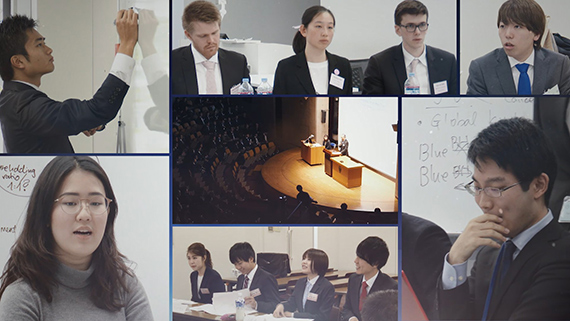
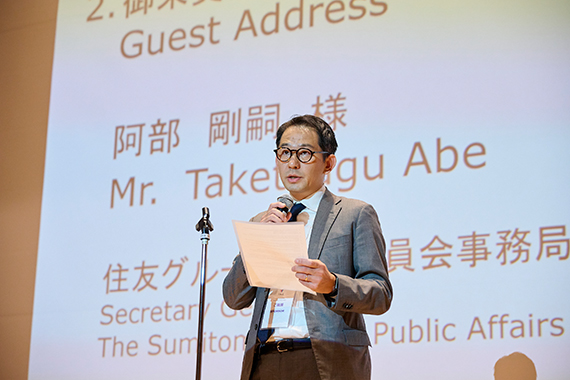
The 24th Intercollegiate Negotiation Competition (INC) was held at Sophia University in Tokyo on November 15 and 16, 2025.
This year, 19 universities from Japan—Hokkaido University, Tohoku University, the University of Tokyo, Waseda University, Sophia University, Chuo University, Gakushuin University, Nihon University, Meiji University, Rikkyo University, Tsukuba University, Hitotsubashi University, Nagoya University, Kyoto University, Doshisha University, Ritsumeikan University, Osaka University, Kyushu University, and Seinan Gakuin University and eight teams from overseas participated—Team Australia, the National University of Singapore, the National University of Mongolia, Peking University School of Transnational Law, George Mason University Korea Campus, Temple University Japan Campus, Tashkent State University of Law, and Fordham University School of Law. 38 teams competed in Japanese and 22 in English.
Tournament chart
<Japanese>
|
Round A / arbitration |
Round B / negotiation |
| Red |
Blue |
Red |
Blue |
| 1 |
Chuo J1 |
Hitotsubashi J2 |
Tsukuba J2 |
Doshisha J1 |
| 2 |
Kyoto J1 |
Tokyo J1 |
Chuo J1 |
Singapore J1 |
| 3 |
Hokkaido J1 |
Nihon J1 |
Tsukuba J1 |
SeinanGakuin J2 |
| 4 |
Meiji J1 |
Rikkyo J2 |
Meiji J2 |
Kyusyu J2 |
| 5 |
Osaka J1 |
Hitotsubashi J4 |
Tohoku J2 |
Hitotsubashi J2 |
| 6 |
Sophia J1 |
Hitotsubashi J1 |
Chuo J2 |
Rikkyo J2 |
| 7 |
Tohoku J1 |
Singapore J1 |
Tohoku J1 |
SeinanGakuin J1 |
| 8 |
Tsukuba J1 |
Kyusyu J1 |
Kyoto J2 |
Hitotsubashi J3 |
| 9 |
Chuo J2 |
Waseda J1 |
Sophia J3 |
Tokyo J1 |
| 10 |
Mongolia J1 |
Waseda J2 |
Kyoto J1 |
Rikkyo J1 |
| 11 |
Osaka J2 |
Tokyo J2 |
Sophia J2 |
Rikkyo J3 |
| 12 |
Sophia J2 |
Doshisha J1 |
Hokkaido J1 |
Kyusyu J1 |
| 13 |
Tohoku J2 |
Rikkyo J3 |
Sophia J1 |
Waseda J1 |
| 14 |
Tsukuba J2 |
Hitotsubashi J3 |
Chuo J3 |
Gakushuin J1 |
| 15 |
Chuo J3 |
Kyusyu J2 |
Ritsumeikan J1 |
Tokyo J2 |
| 16 |
Kyoto J2 |
SeinanGakuin J1 |
Meiji J1 |
Hitotsubashi J1 |
| 17 |
Meiji J2 |
Gakushuin J1 |
Osaka J2 |
Waseda J2 |
| 18 |
Ritsumeikan J1 |
Rikkyo J1 |
Mongolia J1 |
Hitotsubashi J4 |
| 19 |
Sophia J3 |
SeinanGakuin J2 |
Osaka J1 |
Nihon J1 |
<English>
|
Round A / arbitration |
Round B / negotiation |
| Red |
Blue |
Red |
Blue |
| 1 |
Team Australia E1 |
Hitotsubashi E1 |
Team Australia E3 |
Waseda E1 |
| 2 |
Chuo E1 |
Peking E1 |
Meiji E1 |
George Mason E1 |
| 3 |
Kyoto E1 |
Fordham E1 |
Temple E2 |
Hitotsubashi E1 |
| 4 |
Meiji E1 |
Singapore E1 |
Sophia E1 |
Singapore E1 |
| 5 |
Team Australia E2 |
Tokyo E1 |
Chuo E1 |
Tashkent E1 |
| 6 |
Mongolia E1 |
Nagoya E1 |
Team Australia E1 |
Rikkyo E1 |
| 7 |
Team Australia E3 |
Tashkent E1 |
Sophia E2 |
Fordham E1 |
| 8 |
Temple E2 |
Waseda E1 |
Mongolia E1 |
Kyusyu E1 |
| 9 |
Sophia E2 |
Kyusyu E1 |
Temple E1 |
Tokyo E1 |
| 10 |
Temple E1 |
Rikkyo E1 |
Kyoto E1 |
Peking E1 |
| 11 |
Sophia E1 |
George Mason E1 |
Team Australia E2 |
Nagoya E1 |
Problem and the Competition Outline
This year’s problem is set in two fictional countries: Negoland, which promotes cutting-edge AI medical technologies, and Arbitria, which places strong emphasis on safety and ethics. Negoland’s Red Corporation has developed an AI diagnostic support tool called RedAid and has been pursuing a partnership with the prestigious Blue University in Arbitria. Although both countries have advanced healthcare systems, the cultural and institutional differences between innovation-driven Negoland and safety- and accountability-oriented Arbitria play a significant role in the background of the conflict that eventually arises.
In Round A, two arbitration cases were heard. The first, the RedAid Case, arose from a patient’s death during the use of RedAid at Blue University, after which the university suspended its use. An internal investigation report was accidentally disclosed to the public, and the information spread widely. Red Corporation claimed that it suffered business losses due to this leak and sought damages from Blue University on the grounds of a breach of confidentiality. In response, Blue University argued that the accident was caused by a configuration error in RedAid and demanded that Red Corporation compensate it for the payments made to the patient’s family.
The second case, the Tourism Case, concerned a service operated under a special agreement for AI diagnostic support in medical tourism. It came to light that some patient data had been stored on overseas cloud servers, prompting Blue University to initiate arbitration seeking the cessation of such data transfers and compensation equivalent to a penalty Blue had to pay under Arbitrian law. Key themes included how the parties’ agreement should be interpreted in light of the contract and the underlying facts, as well as how to address pressing contemporary challenges such as the risks associated with AI medical devices and the management of sensitive data.
Round B takes place at a stage before the disputes arose. The negotiations focused on two themes: 1) a joint research agreement concerning the AI diagnostic support tool RedAid, and 2) a contract for the implementation of the telemedicine platform RedLink. The two parties considered the contractual terms from their respective standpoints and negotiated the future shape of their cooperative relationship.
Results of the 24th INC
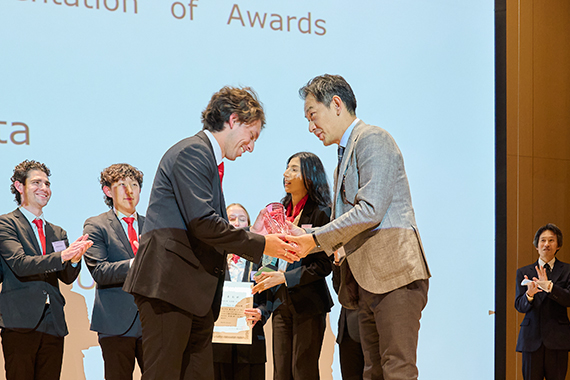
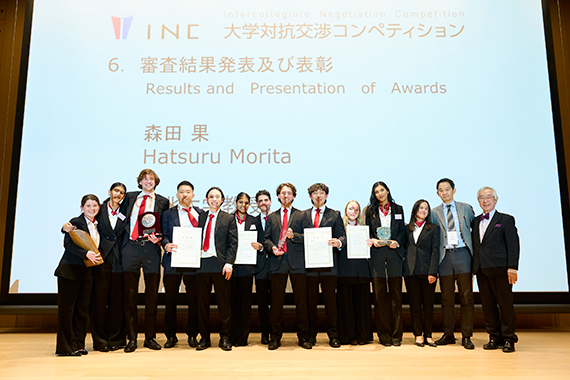
The awards ceremony always has an element of high drama: the joy of the winning team and the disappointment of those who, unfortunately, fell short of their goals. It is a vivid reminder of how seriously all the participants approached the competition and how much passion they invested in it. This year, Team Australia received the first prize as well as the Best Teamwork Award. The highest scores in the Japanese rounds went to the National University of Singapore for arbitration and the University of Tokyo for negotiation. In the English rounds, the highest arbitration score was earned by Kyushu University, while Team Australia achieved the highest score in negotiation.
Results
| 1st prize |
Team Australia |
227.833 points |
| 2nd prize |
Fordham University |
218.5 points |
| 3rd prize |
Sophia University |
212.6 points |
| 4th prize |
Kyushu University |
212.0 points |
| 5th prize |
National University of Singapore |
211.5 points |
| 6th prize |
The University of Tokyo |
210.833 points |
| 6th prize |
George Mason University, Korea Campus |
208.5 points |
| 8th prize |
Waseda University |
202 points |
| 9th prize |
Osaka University |
201.75 points |
| 10th prize |
Chuo University |
200.5 points |
| 10th prize |
Tsukuba University |
200.5 points |
Special Awards
| Best Teamwork Award |
Team Australia |
| Steering Committee Special Award |
National University of Singapore |
Category Awards
| Highest Score in Japanese Division (Herbert Smith Freehills Kramer Award) |
National University of Singapore |
| Highest Score in Japanese Division (GLEA Award) |
The University of Tokyo |
| Highest score for the competition in English for arbitration (CIArb Award) |
Kyushu University |
| Highest score for the competition in English for negotiation (Squire Patton Boggs Award) |
Team Australia |
Results for the competition in Japanese
| 1st prize |
The University of Tokyo |
| 2nd prize |
Kyushu University |
| 3rd prize |
Sophia University |
| 4th prize |
Osaka University |
| 5th prize |
Tsukuba University |
Results for the competition in English
| 1st prize |
Team Australia |
| 2nd prize |
Fordham University |
| 3rd prize |
National University of Singapore |
| 4th prize |
Sophia University |
| 5th prize |
Kyushu University |
Click here to read about previous Intercollegiate Negotiation Competitions.

 EN
EN