Sumitomo and Co-Creation—Articulating a Vision—
Sumitomo Osaka Cement
Cement, the principal ingredient of concrete, is manufactured by firing limestone at high temperatures. During this process, CO2 is emitted not only from the thermal energy required for firing, but also from the thermal decomposition of limestone itself. As a result, the cement industry has long been regarded as one of the major industrial sources of CO2 emissions.
However, Sumitomo Osaka Cement has developed a technology that combines CO2 emitted during cement production with calcium contained in waste to produce calcium carbonate. The company has thereby established a process for producing calcium carbonate comparable in quality to natural limestone. The technology also enables the permanent mineral sequestration of CO2. By transforming CO2—once regarded simply as an emission—into a valuable resource, Sumitomo Osaka Cement is evolving from a source of CO2 emissions into an environmental solutions company.
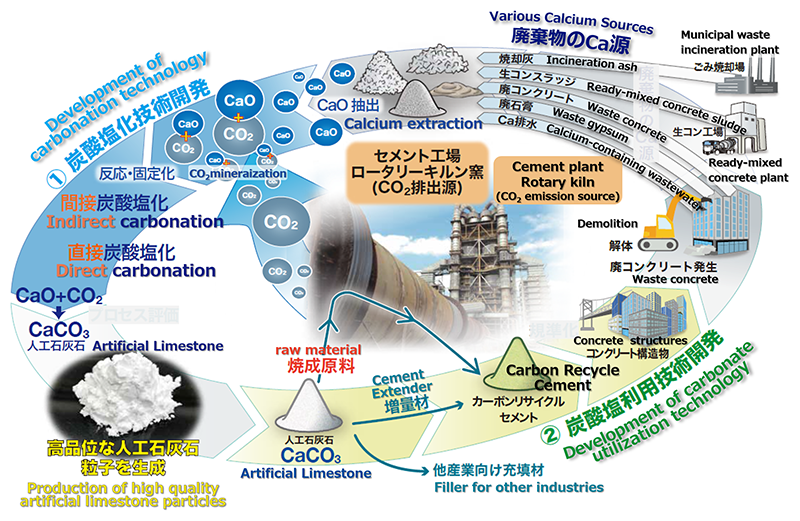
Sumitomo Osaka Cement chose indirect carbonation as its method for transforming CO2 back into minerals. The process first extracts calcium from waste and then reacts it with CO2. Although CO2 can also be permanently incorporated into minerals by directly reacting them with CO2, Sumitomo Osaka Cement deliberately adopted the indirect method despite its greater process complexity and higher cost.
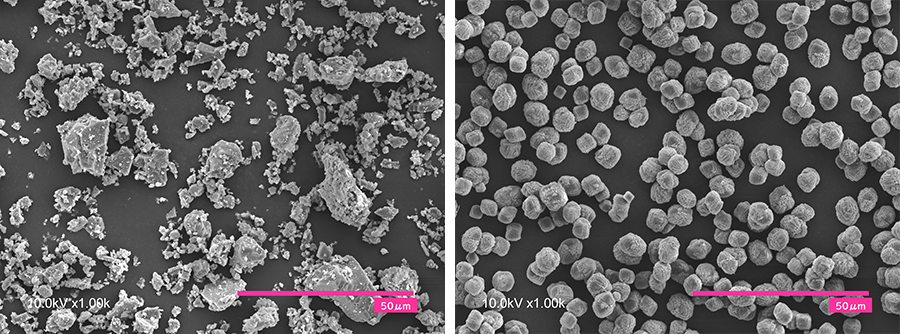
The indirect method offers a significant advantage. It facilitates the production of high-quality calcium carbonate with fewer impurities and a more uniform particle size than natural limestone.
The company began basic experiments around 2020 and, after confirming the feasibility of the technology, applied for a project under the Green Innovation Fund of the New Energy and Industrial Technology Development Organization (NEDO). The proposal was selected in 2022.
At the core of the process is a technology known as bipolar membrane electrodialysis (BMED). Saltwater is electrolyzed to produce acid and alkali, which are then recycled for use in the calcium extraction and CO2 reaction stages, respectively. A key feature of the process is that it eliminates the need to purchase acid or alkali from external sources, as the material cycle is essentially closed within the system. The process is intended to be powered by renewable electricity, with the goal of establishing a manufacturing system that does not rely on fossil fuels.
From 2023 to 2025, the company constructed bench-scale and pilot-scale plants in Osaka and Tochigi Prefectures, respectively, reaching the stage where it can provide mass-production trial samples to potential users. Fiscal 2025 marked the midpoint of the Green Innovation Fund project, with work progressing on establishing the core technology and verifying its cost and CO2 reduction benefits.
Thus, the deliberate decision to take the indirect route by adopting the indirect carbonation method opened the door to a variety of unexpected applications.
The CO2 recycling artificial limestone produced using this indirect method can permanently fix approximately 420g of CO2 per kg. Because the CO2 is permanently sequestered in mineral form, it is not released back into the atmosphere, remaining effectively permanently stored even after products containing the material wear out or naturally deteriorate.
Consequently, advanced, highly efficient carbon capture and utilization (CCU) can be achieved simply by adding CO2 recycling artificial limestone to existing production lines. Users do not need to make large-scale capital investments, and the material has been found to offer quality comparable to that of industrial-grade precipitated calcium carbonate. Industries that use calcium carbonate have taken note of the ease of use and its ability to permanently sequester CO2. As a result, inquiries about potential applications have increased rapidly.
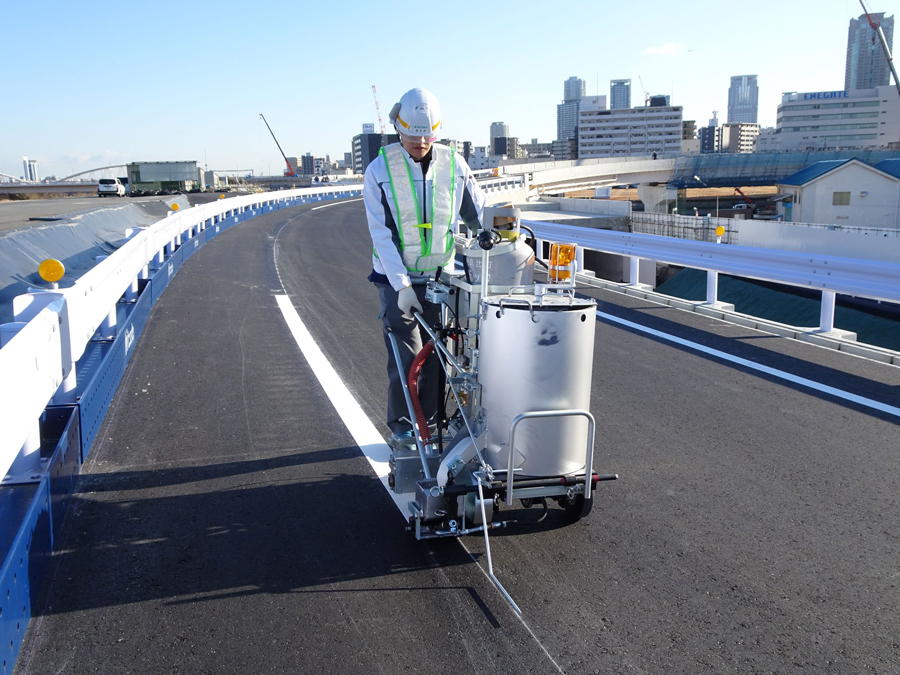
In 2025, the company’s efforts began to yield tangible results. In January, Sumitomo Osaka Cement announced that, together with KICTEC (Nagoya), a leading manufacturer of road-marking materials, it had developed the world’s first road-marking paint using CO2 recycling artificial limestone. Demonstration tests were subsequently conducted on an access route to the Expo 2025 Osaka, Kansai, Japan venue.
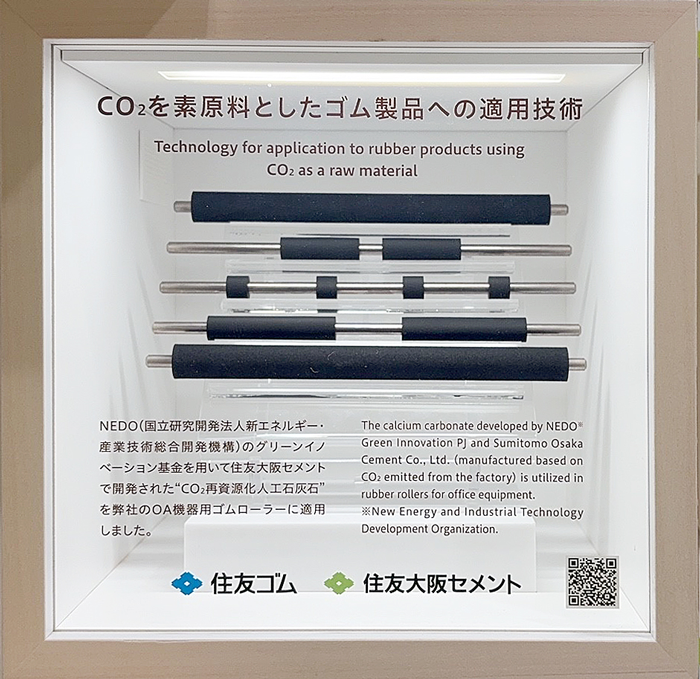
In January 2025, the company announced the development of LOCABO Paper, a low-carbon paper, in collaboration with the paper manufacturers OJI F-TEX (Chuo-ku, Tokyo) and Fukoku Paper (Shinjuku-ku, Tokyo). In February, it announced the development of a composite polypropylene resin with NISSEN POLYTEC (Ozu City, Ehime Prefecture), followed in May by the development of rubber rollers for office equipment with DUNLOP (Sumitomo Rubber) (Kobe).
In just five months, the company announced four world-first developments in rapid succession. A particularly notable example is the road-marking paint developed with KICTEC. Road-marking paint used for stop lines, pedestrian crossings, and other markings could not previously be recycled when removed, resulting in waste. Until then, all the removed material had been disposed of through incineration or landfill.
Sumitomo Osaka Cement and KICTEC established a new circular economy system by collecting this waste road-marking material for use as a raw material in the production of CO2 recycling artificial limestone, which is then incorporated back into new road-marking paint. The result is a circular model that simultaneously delivers three benefits: carbon fixing, waste reduction, and an extended service life for landfill sites.
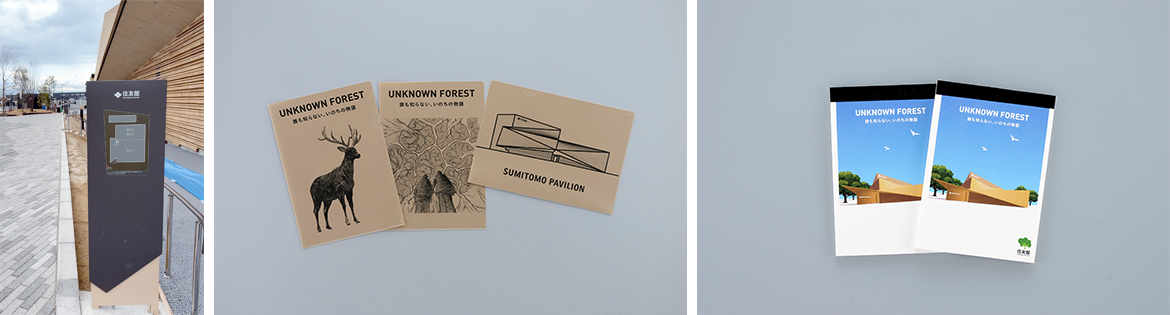
At the Sumitomo Pavilion, which attracted numerous visitors at Expo 2025 Osaka, Kansai, approximately 500 kg of CO2 recycling artificial limestone was used in the surrounding concrete blocks, fixing about 210 kg of CO2. Even merchandise sold in the pavilion’s gift shop, such as plastic document folders and notepads, were made using CO2 recycling artificial limestone.
In the rubber sector, if CO2 recycling artificial limestone were used in all rubber rollers for office equipment produced by DUNLOP (Sumitomo Rubber), annual CO2 emissions could be reduced by approximately 36 tons. Looking ahead, the company is also considering its application to automotive tire rubber, further expanding the potential for decarbonization through inter-industry collaboration between the cement and rubber industries.
Sumitomo Osaka Cement has another environmental technology: its artificial reef for promoting the growth of seaweed beds, which it has been developing since 2002. The system involves submerging concrete artificial reefs in coastal areas affected by seabed desertification—where seaweed has declined dramatically—to encourage the regeneration of seaweed-rich marine habitats. Over the past quarter-century, the company has established a proven track record throughout Nagasaki Prefecture, including its remote islands.
However, conventional artificial reefs for promoting seaweed beds still faced two challenges in the quest to create healthier marine environments: CO2 emissions associated with conventional concrete and concerns about the generation of microplastics from plastic components.
CO2 recycling artificial limestone was the solution. Low-carbon concrete incorporating this material can significantly reduce CO2 emissions. The plastic components have also been replaced by marine-biodegradable materials, and in 2024 the company introduced Moba-King, its next-generation seaweed bed cultivation system.
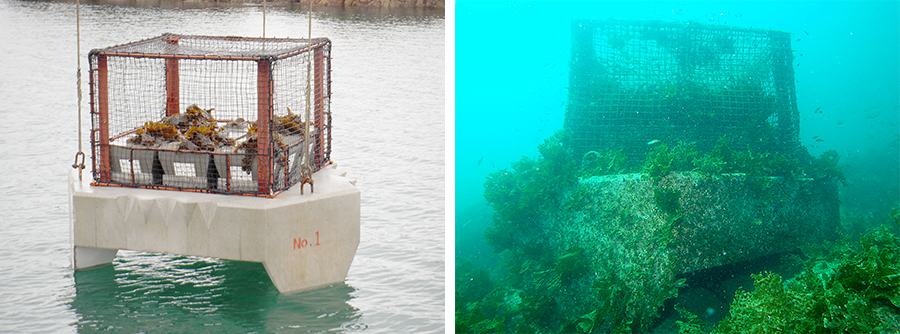
By bringing the CO2 recycling artificial limestone technology it pursued for land-based decarbonization to the marine environment, Sumitomo Osaka Cement has created a unique “blue carbon* ecosystem development business.”
* Blue carbon refers to carbon derived from CO2 absorbed and fixed by marine organisms, including seaweed. The concept has attracted increasing international attention since the 2010s.
The Japanese government’s global warming countermeasures plan, approved by the cabinet in February 2025, sets a target of achieving annual CO2 absorption of 2 million tons through blue carbon by fiscal 2040. That target is also likely to provide a tailwind for Sumitomo Osaka Cement. The company plans to expand the range of coastal areas and seaweed species covered by the system, extending its activities from Nagasaki to the rest of Japan and eventually overseas.
In its medium- to long-term vision, SOC Vision2035, Sumitomo Osaka Cement has set out a strategy to transform its business portfolio by achieving a 50:50 sales ratio between its cement and non-cement businesses by 2035. Between 2023 to 2035, the company plans to invest approximately 500 billion yen in total, including investments in new carbon-related businesses. It is also strengthening its organizational structure by establishing the Carbon Recycling Technology Research Group at the Cement/Concrete Research Laboratory (Funabashi, Chiba Prefecture).
CO2 recycling artificial limestone and Moba-King—these two decarbonization technologies for land and sea represent efforts to leverage the expertise and assets of a cement company to address environmental challenges. Together, they give practical expression to the company’s vision of becoming an environmental solutions company.
 Journalist Shumon Mikawa on Sumitomo’s DNA
 EN
EN