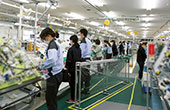
Sumitomo and Co-Creation—Articulating a Vision—
Sumitomo Wiring Systems
Wiring harnesses, often described as the “blood vessels and nerves” of automobiles, are assemblies of multiple electrical wires bundled together with wiring components. Due to their complex structure, their production has traditionally been labor-intensive, requiring a vast amount of manual work. As a result, many companies have adopted a global strategy of production in the most cost-effective locations, shifting operations overseas in search of low-cost labor.
Sumitomo Wiring Systems (SWS), which plays a central role in the Sumitomo Electric Group’s automotive business and holds a world-leading market share for wiring harnesses, has also built an extensive global supply chain network, with more than 100 sites in over 30 countries and approximately 250,000 employees.
However, heightened geopolitical risks, soaring logistics costs, and rising labor costs in emerging economies have highlighted the vulnerabilities inherent in traditional supply models that rely on distant production sites. In this era of uncertainty, SWS is seeking to move away from a system that relies solely on low-cost labor. The company is shifting toward local production for local markets, manufacturing products close to its markets and delivering them promptly.
A key technological innovation driving this transformation is e-STEALTH W/H®, which was introduced to the market in late 2025 following years of research and development.
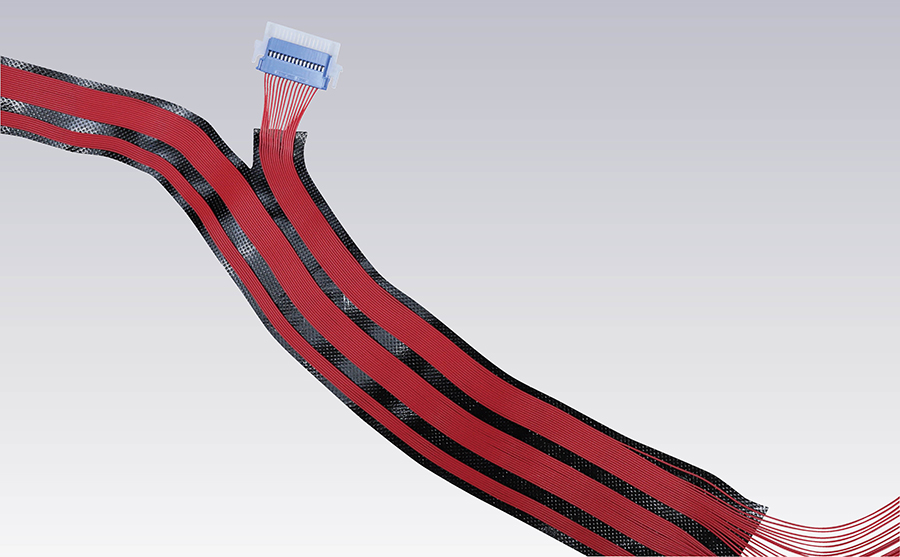
Conventional wiring harnesses consist of bundles of more than 500 intricately intertwined wires. Although progress has been achieved in automating manufacturing processes, automating assembly operations in particular has long been considered extremely difficult. e-STEALTH W/H® fundamentally challenges this conventional wisdom. Its most distinctive feature is the complete separation and modularization of the vehicle’s complex wiring into main and branch lines.
Moreover, using its proprietary technology, SWS has developed a configuration in which the wires forming the thick main line are arranged side by side in a flat structure. This flat design achieves dramatic space savings and weight reduction compared with conventional round wiring harnesses.
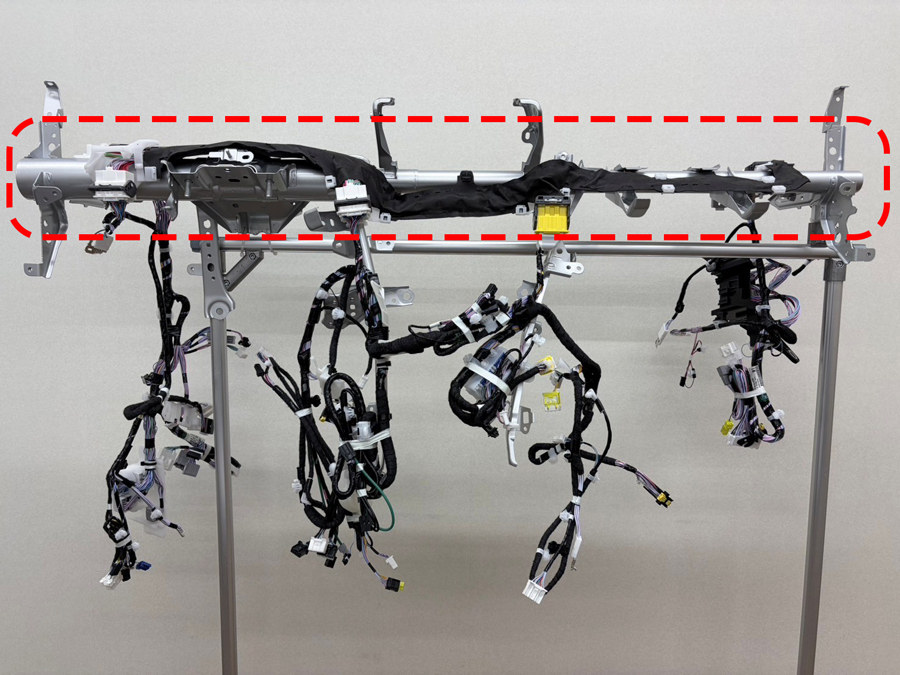
This technological innovation offers significant benefits to automakers. In vehicle applications, it has enabled highly efficient use of the space inside the instrument panel, helping to reduce the overall height of the instrument panel by approximately 40 mm. This gives drivers a wider field of view while significantly improving design flexibility and cabin comfort.

The benefits are also significant from business and logistics perspectives. By transporting the main lines in flat-packed form rather than as bulky, fully assembled wiring harnesses, and performing final assembly close to customer locations, SWS can significantly reduce transportation costs and storage space requirements.
For SWS, e-STEALTH W/H® is more than just a new product; it is an important tool for transforming the very nature of manufacturing. The company aims to reduce the burden on workers, enabling them to focus on more sophisticated decision-making and value creation, while creating a smart factory where anyone, anywhere in the world, can manufacture products efficiently and to the same quality standards.
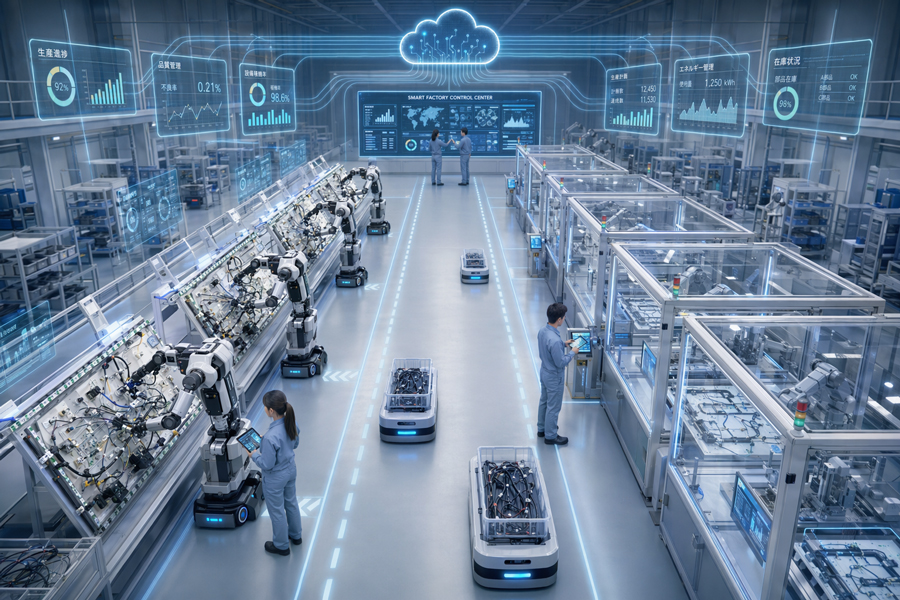
The key lies in combining advanced digital technology and on-site expertise. For example, SWS uses AI-based skeletal tracking technology to digitize workers’ movements. Procedures and subtle techniques that experienced workers have traditionally performed intuitively can now be precisely visualized through skeletal tracking and converted into systematic, explicit knowledge. This enables training tailored to diverse workers around the world, laying the foundation for rapidly reducing variations in production speed and quality.
As a further step, the company has begun an initiative in which experienced factory leaders wear AR glasses (augmented reality goggles) to collect and analyze data on where they look, what they focus on, and how they make decisions on the factory floor. The knowledge gained in this way is then used to train a multi-agent AI system (a system in which multiple AI agents work as a team, each performing assigned tasks autonomously).
Furthermore, tasks previously performed by humans will be handled using physical AI (AI that uses cameras and sensors to perceive the real world and controls physical systems, such as robots, to perform tasks). Conventional industrial robots could operate only at fixed preprogrammed positions, making them unsuitable for manufacturing wiring harnesses, which are flexible and can change shape. However, introducing physical AI with autonomous decision-making capabilities makes it possible to build highly integrated production lines where humans and robots work closely together.
Moreover, AI detects early warning signs of potential problems and issues instructions. Even when multiple anomalies occur simultaneously, it autonomously determines priorities to optimize overall operations. As a result, the company is progressing toward factory operations with minimal risk of downtime.
The development of smart factories with the highest possible levels of automation has the potential to overcome the long-standing challenge of high labor costs in Japanese manufacturing. SWS has a clear vision for the future: achieving reshoring of manufacturing while expanding local production for local markets.
If manufacturing costs can be brought into line globally, there will no longer be a need to rely on low-cost labor overseas. Reestablishing a robust mass-production system in Japan would not only strengthen supply chain resilience against geopolitical risks but also restore Japan’s position as the world’s flagship hub for mass production. Ultimately, this would help restore Japan’s industrial strength and pride in its manufacturing capabilities. Outside Japan, SWS is also embracing local production for local markets, manufacturing products at factories close to customers.
The technology developed by SWS has enormous potential for applications beyond automobiles, including flying cars, space rockets, and robots for the caregiving and service sectors. The use of such robots is expected to expand rapidly worldwide.
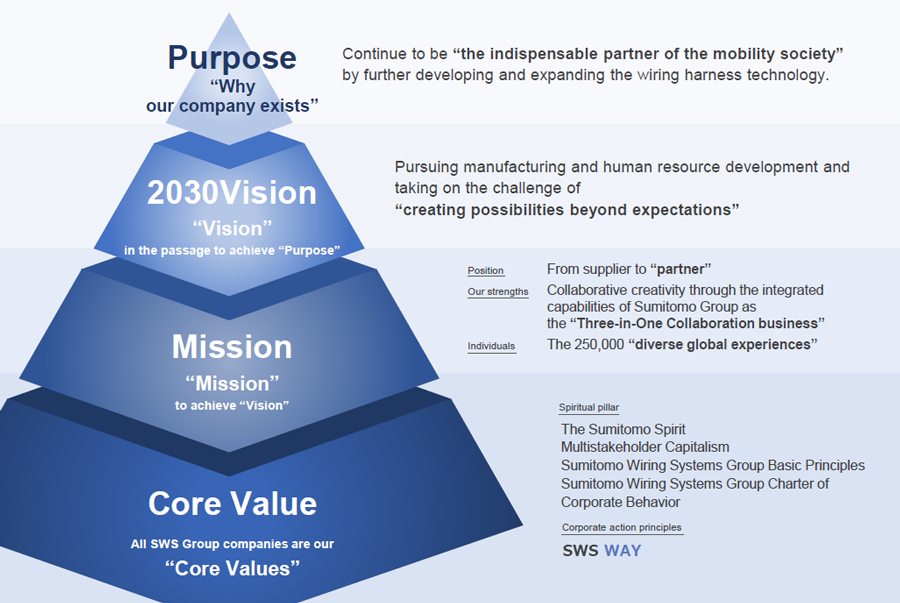
At the heart of these ambitious initiatives lies the SWS WAY, a set of principles guiding everyday conduct. This fundamental philosophy is shared by SWS, Sumitomo Electric Industries’ Automotive Business Division, and the jointly owned AutoNetworks Technologies, which together form the “Three-in-One Collaboration business.” Guided by these principles, SWS continues to evolve as an “indispensable partner of the mobility society.”
 Journalist Junichiro Hori on Sumitomo’s DNA

 EN