Supporting decarbonization with One Click LCA, a tool for visualizing building CO2 emissions
Globally, the construction sector accounts for approximately 40% of total CO2 emissions, making decarbonization an urgent priority. To date, efforts to reduce CO2 emissions from buildings have focused primarily on energy-saving measures aimed at lowering operational carbon—emissions generated during the post-construction operational phase, such as heating and cooling. More recently, attention has turned to reducing embodied carbon, which is emitted across the entire life cycle of a building, from material procurement and manufacturing through construction, demolition, and disposal.
Against this background, growing attention is being paid to One Click LCA, a tool that visualizes greenhouse gas (GHG) emissions, including those of CO2, generated throughout a building’s life cycle, from material procurement and construction to demolition and disposal. One Click LCA is building life cycle assessment (LCA) software, for which Sumitomo Forestry is the authorized distributor in Japan.
CO2 emissions at each stage of a building’s life cycle (Courtesy of Sumitomo Forestry)
Rapid progress toward the institutionalization of embodied carbon
According to “Building Materials and the Climate: Constructing a New Future,” a report published by the United Nations Environment Programme (UNEP) in 2023, embodied carbon is projected to account for approximately 49% of total emissions in the construction sector in 2050. As a result, the importance of reducing embodied carbon has increased rapidly in recent years.
In response to this international trend, discussions toward the institutionalization of embodied carbon are gaining momentum in Japan. In December 2022, the Ministry of Land, Infrastructure, Transport and Tourism (MMLT) established the Zero Carbon Building Promotion Council, and preparations are currently underway with the aim of introducing regulations in 2028. Under the initial proposal, developers of office buildings and other large-scale projects with a total floor area of 5,000 square meters or more would be required to submit embodied carbon assessment results to a public authority prior to the start of construction. Similar initiatives are emerging at the local government level. In Tokyo, for example, starting in April 2025, the Building Environmental Planning System will introduce “the assessment and reduction of CO2 emissions during construction” as an additional scoring item for buildings with a total floor area of 2,000 square meters or more.
Sumitomo Forestry has been actively addressing this issue by participating in the Zero Carbon Building Promotion Council and its working groups, where it has been involved in discussions on standardizing calculation requirements. Against this backdrop, the company signed an exclusive distribution agreement in 2022 with Finland-based One Click LCA Ltd., and began offering a Japanese-language version of One Click LCA software in August of that year.
Key strengths include a comprehensive database of around 150,000 datasets, alignment with international standards, and seamless BIM integration
One Click LCA visualizes CO2 emissions by calculating them from the quantities of building materials used and their associated environmental impact data.
One Click LCA has three key features. The first is its extensive database, which enables highly accurate calculations. When calculating CO2 emissions, the software uses coefficients defined for each type of activity—such as electricity consumption, transportation distances, waste volumes, and material quantities. These coefficients are generally referred to as “emissions factors.”
With respect to building materials, the system developed by the Japanese government defines several hundred emissions factors. By contrast, One Click LCA defines these factors in much greater detail and has built a database comprising approximately 150,000 datasets. For example, even within the category of wood, there is a wide range of product types--such as sawn timber, engineered wood, and LVL (laminated veneer lumber)—and emission factors are defined in detail to reflect these differences. As a result, more accurate calculations can be obtained at the design stage. In addition, by incorporating environmental impact data that has been verified by third parties under the framework of Environment Product Declarations (EPDs), the reliability of the calculation results is ensured.
The second feature is compliance with international ISO standards. Because One Click LCA is ISO-compliant, it enables the preparation of highly reliable reports that conform to globally recognized evaluation standards.
The third feature is its ability to integrate with Building Information Modeling (BIM), a widely used method for building design and management, thereby improving operational efficiency. By importing data such as material quantities directly from BIM design models, the burden of manual data entry can be significantly reduced. This, in turn, allows faster iterative simulations at the design stage. By comparing different materials and structural options before construction begins, designers can more easily identify optimal solutions for reducing CO2 emissions.
Visualizing emissions at the design stage to support decision-making
One Click LCA has been increasingly adopted by general contractors, design firms, local governments, academic institutions, and other organizations, generating a wide range of tangible benefits. For example, at Port Plus, a wooden experimental building constructed within Obayashi Corporation’s next-generation training facility, CO2 emissions were calculated and compared across different structural types—including steel-frame (S) and reinforced concrete (RC) construction—using One Click LCA. The results quantitatively demonstrated wood’s environmental advantage, showing that opting for wooden construction can significantly reduce embodied carbon emissions compared with other structural systems.
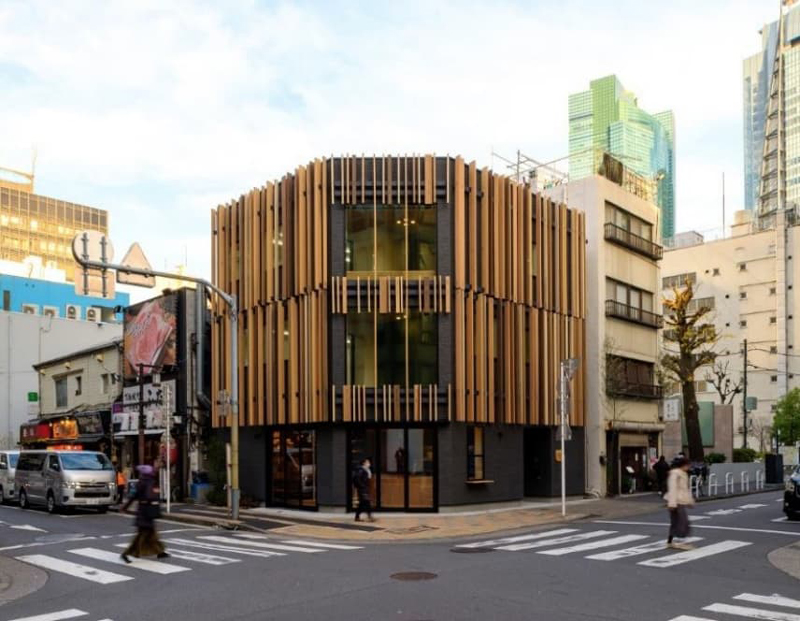
Another example designed using One Click LCA is Shimbashi Platform, a wooden structure embodying environmental considerations as part of Nomura Real Estate’s urban redevelopment project at the west exit of Shimbashi Station. The building was conceived as a hub for sustainable, future-oriented urban development, and incorporates various measures to reduce CO2 emissions during the construction phase. In addition, the project envisions that, after eventual dismantling, a portion of the wood used will be reused, further lowering lifecycle emissions.
Shimbashi Platform (Courtesy of Nomura Real Estate)
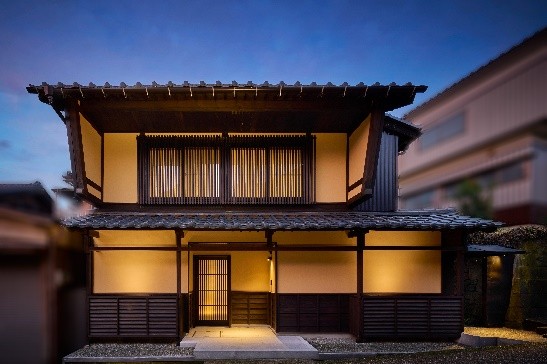
In the renovation of Auberge Homachi Mikuniminato, a townhouse hotel in the Mikuniminato area of Sakai City, Fukui Prefecture, undertaken by Sumitomo Forestry, One Click LCA was also used to quantitatively demonstrate the emissions-reduction benefits of renovating an existing building. Based on simulation results generated with One Click LCA for one of the historic townhouse building, the project adopted a policy of reusing part of the existing structure rather than opting for complete reconstruction. As a result, it was shown quantitatively that CO2 emissions during construction could be reduced by approximately 15% compared to rebuilding.
Auberge Homachi Mikuniminato (Courtesy of Sumitomo Forestry)
Contributing to society by serving as a decarbonization platform for the entire industry
As these examples demonstrate, One Click LCA quantitatively visualizes corporate efforts such as material selection and design improvements, and serves as a foundation for fostering a market in which environmental considerations are properly valued.
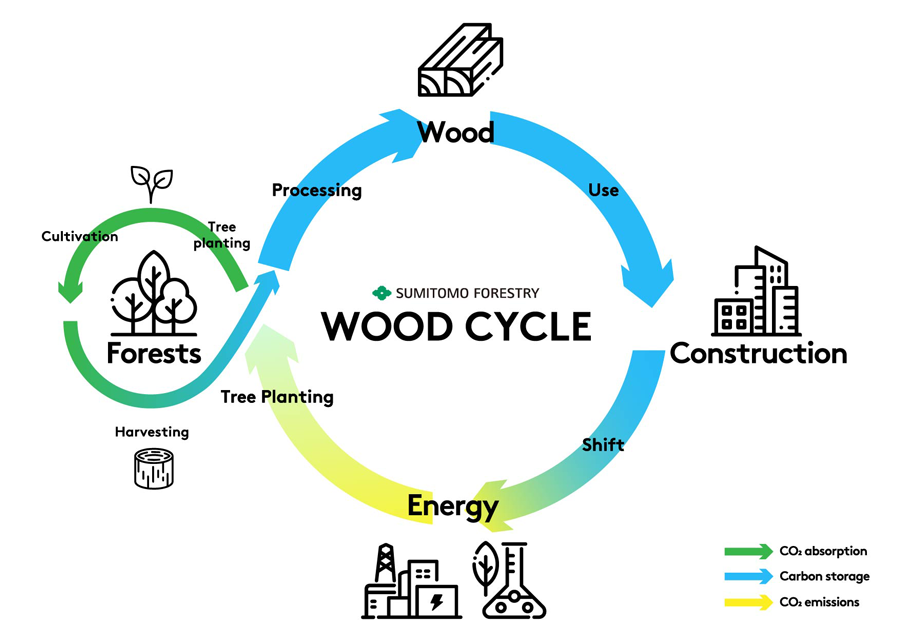
Under its long-term vision, Mission TREEING 2030, the Sumitomo Forestry Group promotes the “WOOD CYCLE,” developing a value chain that spans forest management, lumber manufacturing and distribution, wooden construction, and biomass power generation. By increasing the amount of CO2 absorbed by forests and storing carbon over the long term in wood products and wooden buildings, the Group aims to contribute to the realization of a decarbonized society.
By promoting the wider adoption of One Click LCA—together with wood utilization based on the WOOD CYCLE—Sumitomo Forestry aims to advance decarbonization across the entire industry and contribute to the realization of a sustainable society.
Sumitomo Forestry Group's “WOOD CYCLE” (Courtesy of Sumitomo Forestry)
Journalist Junichiro Hori on Sumitomo’s DNA
Sumitomo Forestry’s corporate philosophy reads: “The Sumitomo Forestry Group utilizes wood as a healthy and environmentally friendly natural resource to provide a diverse range of lifestyle-related services that contribute to the realization of a sustainable and prosperous society. All our efforts are based on Sumitomo’s Business Spirit, which places prime importance on fairness and integrity for the good of society.”
This philosophy clearly declares the Group’s commitment to contributing to the realization of a sustainable and prosperous society by leveraging wood, in line with Sumitomo’s business philosophy. The One Click LCA initiative featured in this article demonstrates that this commitment is not merely aspirational. By quantitatively verifying the benefits of substituting wood for conventional building materials, the initiative provides concrete evidence of the value of wood-based solutions. The steady expansion in usage can be seen as a reflection of Sumitomo’s business Spirit underpinning the business.

 EN
EN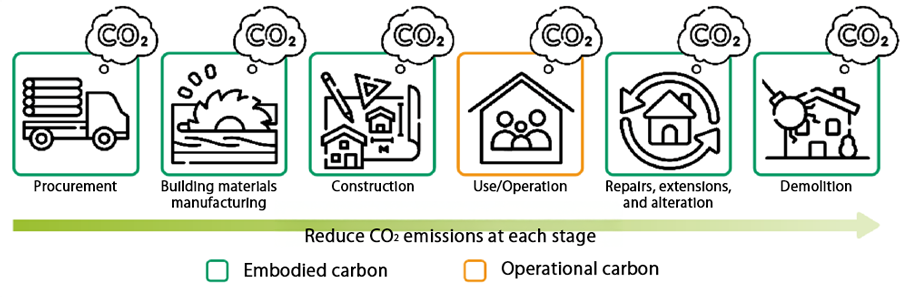
 Journalist Junichiro Hori on Sumitomo’s DNA