Sumitomo and Co-Creation—Articulating a Vision—
Meidensha
Even though electricity is indispensable in our daily lives, we rarely give much thought to the “circuit breakers” used in high-voltage power systems. However, without these circuit breakers, major accidents caused by electrical leakage or overcurrents in high-voltage power lines could not be prevented. Today, notable innovations are currently underway in these indispensable “guardians of electric power.”
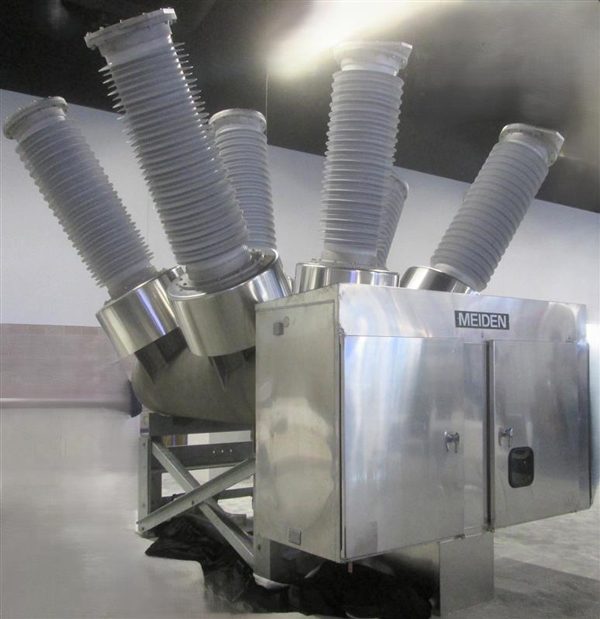
In power systems, vacuum circuit breakers have long been used for lower voltages within the high-voltage range, while SF6 gas (sulfur hexafluoride) has been used for higher voltages. SF6 gas has excellent insulating properties and can quickly extinguish electrical arcs during switching. As a result, it became possible to miniaturize high-voltage circuit breakers, and SF6 came to be regarded as an ideal gas.
However, under the 1997 Kyoto Protocol, SF6 was designated as a greenhouse gas. Its global warming potential (GWP) is a staggering 23,500 times that of carbon dioxide.
As climate action becomes an urgent global priority, the state of California introduced regulations on SF6 gas equipment in January 2025. In Europe, regulations will also be tightened in stages starting in 2028. The circuit breaker sector, which underpins power infrastructure, now stands at a crossroads.
Meidensha, which holds a top-tier share of the domestic and international markets for vacuum circuit breakers, embarked on a bold innovation: applying its vacuum circuit-breaking technology to high-voltage systems. Vacuum circuit breakers do not use gas; instead, they interrupt current by separating electrodes in a vacuum. By using dry air instead of SF6 gas as the insulating medium, it is possible to achieve zero greenhouse gas emissions.
However, in the past, it was difficult to apply vacuum circuit breakers for high voltages. The core component of a vacuum circuit breaker is the vacuum interrupter. To enhance the performance of the vacuum interrupter, simply manufacturing it according to the design drawings is insufficient; special treatments, such as those applied to machined surfaces, are also required.
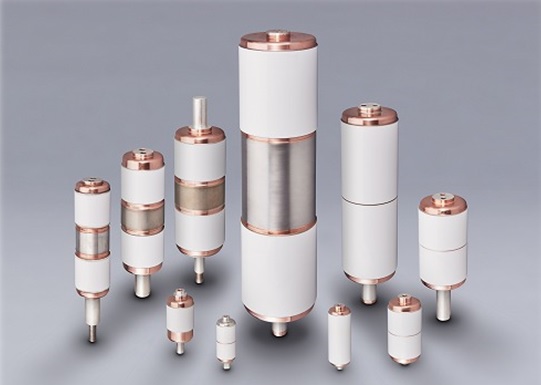
One such process is known as “conditioning.” It involves applying high voltage or passing a large current through the product to strengthen the electrode contacts. Meidensha boldly took on this technological challenge.
In current conditioning, which involves passing a large current, the copper-chromium electrode material is melted and then rapidly cooled to form a finely dispersed chromium layer, thereby dramatically improving withstand voltage performance. In voltage conditioning, high voltage is applied to remove fine protrusions from the electrode surface, smoothing it and enabling operation at even higher voltages.
Meidensha’s strength lies in its ability to achieve an optimal balance between these two processes. Determining that balance requires years of accumulated expertise.
In the 1960s, Meidensha began developing vacuum circuit breakers through a technical partnership with General Electric (GE) of the United States. At the time, GE faced challenges in production technology, and vacuum processing did not proceed smoothly, making commercialization difficult. However, Meidensha overcame these challenges through meticulous design in production engineering and rigorous manufacturing control. This can be seen as a case in which the distinctive strengths of Japanese manufacturing were put to good use.
The development of SF6 gas circuit breakers also progressed during the 1970s. However, following the classification of SF6 gas as a greenhouse gas, Meidensha ventured in the 2000s into uncharted territory: the development of SF6-free high-voltage vacuum circuit breakers—a feat that no one had previously achieved. In 2007, the company released a 72.5 kV dry-air-insulated tank-type vacuum circuit breaker in the U.S. market. In 2020, it put the 145 kV class into practical use. Currently, for the 204 kV class, the company has adopted a proven double-break configuration in which two vacuum interrupters are arranged in series to share the voltage.
Dry-air-insulated vacuum circuit breakers do not pose a risk of greenhouse gas leakage and are easy to maintain. SF6 gas circuit breakers may become inoperable under extremely low-temperature conditions due to gas liquefaction, but dry-air-insulated vacuum circuit breakers are free from this risk. They have been operating for more than 20 years without major malfunctions, even in harsh, extremely cold environments, such as Alaska in the U.S.
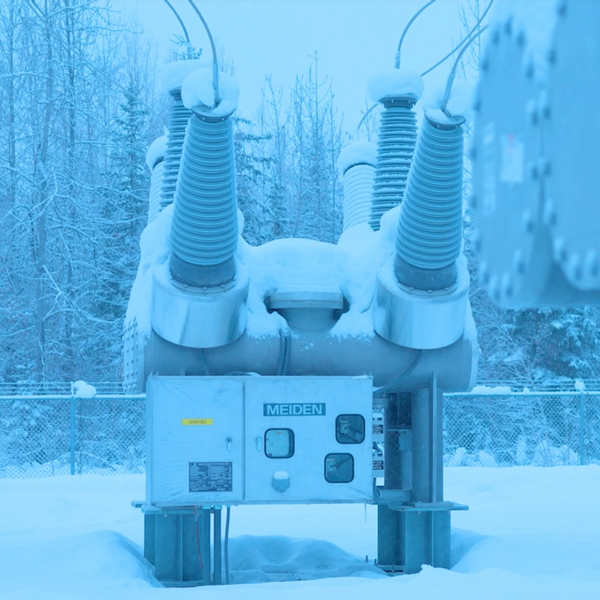
Thanks to these strengths and technical capabilities, Meidensha’s vacuum circuit breakers have gained worldwide recognition. The company has a proven track record of delivering more than 4,000 units globally, including over 2,000 units in North America. While many competitors are developing products that use alternative gases such as NOVEC or CO2 to replace SF6 gas, very few companies have succeeded in achieving high-voltage vacuum circuit breakers using dry-air insulation. As a result, Meidensha has become a distinctive presence globally.
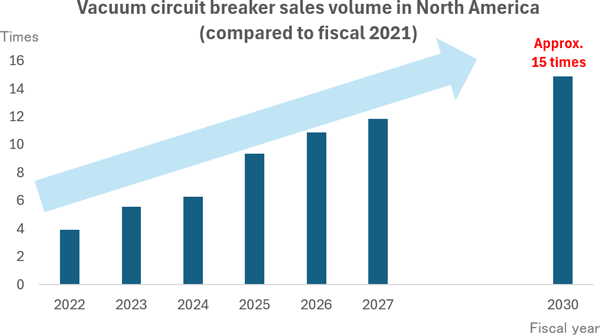
Since regulations on SF6 gas took effect in the United States in January 2025, sales of SF6-free vacuum circuit breakers have been growing steadily. Preparations are also underway in Europe ahead of the regulations taking effect in 2028. The market for high-voltage circuit breakers is growing at an annual rate of 3% to 5%, driven by the replacement of aging power infrastructure and the need for environmental compliance. In particular, in Europe, where seismic activity is relatively low, Meidensha aims to expand sales of insulator-type vacuum circuit breakers, in which vacuum interrupters are arranged vertically within ceramic insulating tubes.
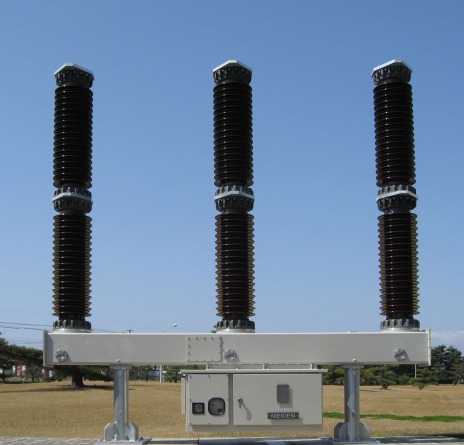
Although the technological hurdles are high, Meidensha intends to take on the challenge of further increasing the voltage and capacity of its vacuum circuit breakers.
At the same time, Meidensha is also focusing on environmentally conscious design, including compact and lightweight products, higher efficiency, the promotion of recycling and reuse, and the elimination of prohibited substances. The company plans to visualize CO2 emissions across the entire product lifecycle and to advance the development of products with lower environmental impact.
Meidensha has set carbon neutrality by 2050 as a long-term vision and has announced the Third Meiden Environmental Vision. The company is committed to contributing to the realization of a decarbonized society through three core initiatives: (1) decarbonizing its own business operations, (2) supporting the decarbonization of customers and society through its products and services, and (3) developing technologies that underpin the green transformation of social infrastructure. Thus, Meidensha will continue to help shape the future of power infrastructure.
 Journalist Shumon Mikawa on Sumitomo’s DNA
 EN
EN